

Who I Help
I help patients who aren’t getting answers, uncover what’s really driving their symptoms without the exhausting cycle of trial-and-error care.
I work primarily with adults with chronic illness, mold-related illness, and nervous system dysregulation. Teens may be considered on a case-by-case basis.
My specialty is helping those with toxic mold exposure and/or patterns of nervous system dysregulation as contributors to their illness, which I find is a HUGE percentage of those with chronic “mystery” illnesses. Most doctors don’t even consider these as potential causes for illness, and neither issue is easy to heal from without expert help.
I know that at this point, you’re probably exhausted from trying to figure out what’s going on or how to get better, manage symptoms, and find the right doctor that can help….and it’s all too much on top of feeling like crap.
I get it. I’ve been there. I know how it feels to have doctors give you their half-attention, focusing only on one symptom, giving you “band-aid” treatments to just manage each symptom, without ever looking deeper for why it’s happening, and addressing the bigger picture.
It doesn’t have to be that way.
My job is to alleviate your burden. I can help you break free from this exhausting cycle, uncover what’s really going on, and show you the way to relief.
Trauma and nervous system healing sessions are available to clients anywhere in the world.
Naturopathic medical care is currently available to residents of Oregon and Colorado through telemedicine.
A short, no pressure call to see if we’re a good fit.
Conditions
Environmental toxicity and nervous system dysregulation are two of the most commonly missed drivers I look for in complex chronic illness. They can contribute to symptoms across nearly every body system, which is why people are often given separate labels for problems that may be connected underneath the surface.
All of the below symptoms and conditions can be caused or partly fueled by these two drivers of disease, especially when they appear in clusters or don’t respond as expected to standard care.
While I always address every patient & condition in a comprehensive way by looking for all potential drivers, I find that when we address the elephant(s) in the room, the body can often recover completely even with other more minor stressors still present.
Immune:
Itching/Flushing
Hives & Rashes
Worsening Allergies
Asthma
Chronic sinus symptoms or recurrent infections
Lyme & Co-Infections
Frequent or chronic viral infections
Recurrent yeast infections
Fungal skin infections
Long COVID
Autoimmunity
Histamine Intolerance
MCAS
Digestive:
Bloating
Undigested food
Constipation
Diarrhea
Nausea/Vomiting
Leaky gut
IBS
SIBO
Food Allergies & Intolerances
Microbiome Imbalances
Sensitivities to:
Foods
Chemicals
Smells
EMFs
Musty Places
Light
Sound
Overstimulation
Pain & Debility:
Chronic Fatigue (& CFS)
Headaches
Migraines
Muscle Pain
Joint Pain
Pelvic/Urinary Pain
Dysautonomia/
POTs
Hormones & Metabolism:
Low Thyroid
Hyperthyroid
Unexplained weight gain
Sugar Cravings
Low Cortisol
High Cortisol
Low Progesterone
Low Testosterone
High or Low Estrogen
Cognition & Mood:
Brain Fog
Concentration Issues
Memory Problems
Anxiety
Panic Attacks
Depression
Irritability
Difficulty Sleeping/Insomnia
Feeling out of body
Miscellaneous:
Frequent static shocks
Metallic Taste in the Mouth
Night Sweats
Frequent Urination
Foul smelling sweat
Nutrient deficiencies
How The Process Works
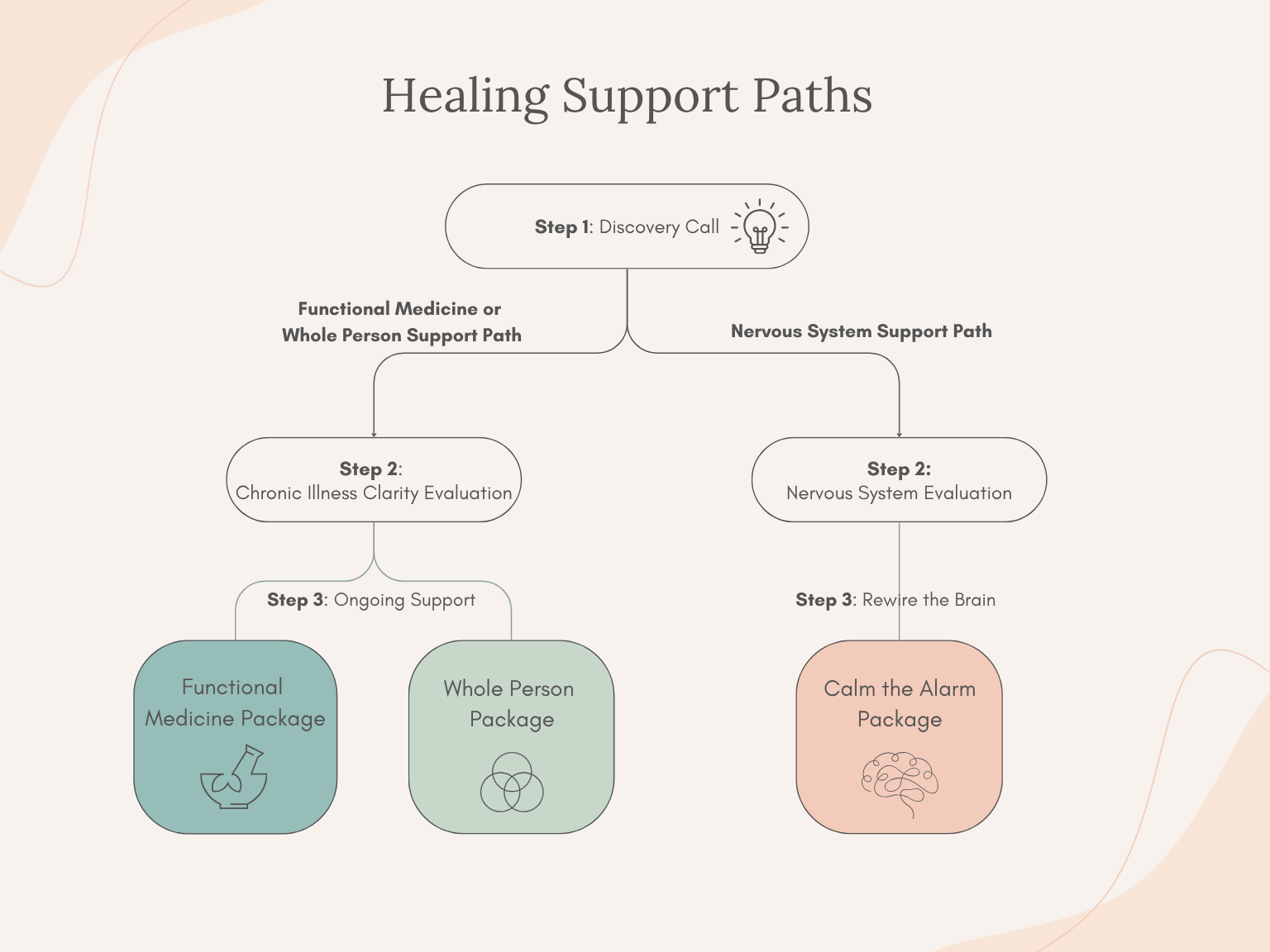
This work goes deeper than symptom management, supplement protocols, or nervous system tools alone. Together, we look at what is keeping your body and nervous system stuck, then build a clear, personalized path that empowers you to clear the obstacles to your healing.

Discovery Call:
We start with a brief 15 minute chat to see if we might be a good fit to work together, and which path might fit best.

Evaluation:
We do a deep dive evaluation from either a functional medicine or nervous system patterning lens or both to create a healing plan.

Personalized Path:
We choose what seems most needed for your healing now - a functional medicine approach, nervous system repatterning or both.

Ongoing Support:
Follow-up appointments during active treatment are every 2-6 weeks depending on the level of care you need at the time.

Healing Support Paths
You don’t need to choose the right path before we talk.
During your Discovery Call, I’ll help determine whether your next step is a deeper chronic illness evaluation or a nervous system only evaluation. After an in-depth evaluation, we’ll decide on the details of your support.
The goal is to match the level of support to what your body and nervous system actually need, not to force you into a one-size-fits-all program.
A Different Approach to Chronic Illness
Most of the people I work with have already tried a lot.
They may have seen conventional doctors, functional medicine providers, naturopaths, specialists, nutritionists, mold practitioners, therapists, and tried various nervous system programs. They’ve spent thousands, only to be told “your labs are normal,” or handed a one-size-fits-all protocol that didn’t work.
In my experience, this happens because the care has been incomplete, poorly sequenced, or not personalized enough to the full complexity of what is going on.
Many approaches focus on one piece at a time: the gut, the hormones, the inflammation, the infections, the mold exposure, the trauma, the anxiety, the diet, or individual symptoms.
But complex chronic illness often requires a wider lens.
I do things differently:
I take on fewer cases at a time so you get the depth and attention your case deserves
I investigate the deeper root causes and diagnostics that most providers won’t explore
I create a customized plan tailored to your unique nervous system & body that addresses all parts of you needing healing - mind, emotions, nervous system, and body.
I address both the physical drivers and the nervous system patterns that can keep your body from healing.
And I provide a high support container, so you never feel alone.
Step 1:
Chronic Illness Clarity Evaluation
My work begins by looking at the full pattern of your health: your symptoms, history, environment, prior labs, sensitivities, nervous system state, treatment tolerance, stressors, trauma history, and what has or hasn’t worked so far.
Along with this thorough evaluation, we also do a comprehensive diagnostic workup using specialized lab tests tailored to your case. This deep dive allows me to explore all possible mechanisms behind your symptoms and uncover connections that others may have missed.
One of the main reasons you’ve continued to struggle is that no one has taken the time to look at your full story. My approach involves thoughtful investigation, considering how your various body systems, your nervous system, and your environment are interrelated.
Many clinics are built around volume. They charge less upfront, but the doctors have to take on so many patients that their attention to your case is limited to say the least. Every patient gets the same standard tests, the same general protocol. Between visits, support is often limited or unavailable, leaving patients to troubleshoot on their own until their next appointment.
I take a different approach. Your care is comprehensive and my priority from the start. You have direct access to me between visits for guidance and next steps. Nothing gets overlooked, and you’re never left wondering what to do next.
This is an investment that saves you time, money, and frustration in the long run. Instead of spending years and thousands on piecemeal visits, random supplements, and surface-level lab work, we identify the real root causes early on, so you can stop guessing, start healing, and finally move forward with confidence.
Step 2:
Steady Ground
Functional Medicine or Whole Person Follow-up Care
After your initial workup, follow-up appointments are typically every 2-6 weeks when you’re in active treatment.
Once you’re in a maintenance phase, we space follow-ups out further.
The goal of this model of care is that we are both committed to transforming your health as much as possible during that period of time, so that you get better and faster results. I find that my patients who get better the fastest, are the ones who receive frequent, consistent care, accountability, and support.
With your commitment to regular follow-up, I can also show up and support you more deeply, by taking on fewer clients.
My goal is always to empower my patients to get well and stay well, so you no longer need me, but to get there, I need your dedication to your own healing process.
A Different Approach to Nervous System Healing
If you’ve tried a lot of things to help your nervous system feel calmer and more regulated, but you still feel stuck in survival mode, it does not mean you failed.
It may mean the approach was too generic or didn’t actually heal the root cause of why your nervous system is so dysregulated.
Just like getting to and properly healing the root cause is essential from a medical perspective, it’s also essential for many people to create a consistently regulated nervous system.
That’s why meditation, breathing exercises, therapy, various approaches to trauma work, and brain retraining programs may not have given you full or lasting results.
Some of those tools may have helped a little.
But for many people with chronic illness, mold-related fear, sensitivity, anxiety, shutdown, or reactivity, the nervous system still doesn’t fully shift.
That’s often because the deeper patterns keeping the system on high alert haven’t actually been updated.
You may understand that you’re safe now.
You may know your reactions are disproportionate.
You may have tools to calm yourself down in the moment.
But your body may still respond as if danger is present.
That is the difference between managing nervous system symptoms and actually changing the patterns underneath them.
My approach is different because we are not just practicing regulation skills or giving you a set of exercises to repeat on your own.
In one-on-one sessions, we use personalized brain rewiring and memory reconsolidation-techniques to identify and update the specific patterns, memories, emotional learnings, beliefs, and protective responses that are keeping your nervous system stuck.
This work is especially helpful when your symptoms are connected to:
Health-related fear or trauma
Mold or environmental hypervigilance
Sensitivity to foods, chemicals, light, sound, EMFs, or bodily sensations
Anxiety, panic, shutdown, or overwhelm
Feeling unsafe in your body or environment
Difficulty tolerating treatment
Chronic illness grief, loss, or identity changes
Patterns of bracing, scanning, rumination, or waiting for symptoms to get worse
This is not about convincing yourself to be calm.
It is about helping your nervous system update the places where it learned that symptoms, environments, your body, or life itself are not safe.
Because the work is personalized and happens in real time, we can follow what your system is actually doing instead of asking you to apply a generic protocol.
For many people, that allows for deeper and more lasting change than approaches that only teach coping tools, relaxation practices, or daily exercises.
The goal is not simply to feel calmer for a few minutes.
The goal is to help your brain and body begin to operate from a more stable baseline of safety, so healing, treatment tolerance, emotional resilience, and daily life can become easier.
Step 1:
Nervous System Evaluation
If during our discovery call, it seems like you may really benefit from nervous system work on its own for now, the next step is a 90 minute Nervous System & Trauma Evaluation.
During that meeting, we’ll review your symptoms of nervous system dysregulation, nervous system patterns and triggers, and trauma history.
This 90-minute evaluation helps determine whether personalized brain rewiring support is the right fit. It’s a space to get all your questions answered about what it’s like, how it works, and everything else.
If it feels like the right fit for both of us, we’ll talk in depth about what the Calm the Alarm sessions will entail and formulate a plan for your rewiring journey with me.
Step 2:
Calm the Alarm Program
In Calm the Alarm, we use memory reconsolidation techniques to update your brain’s wiring, like the software on a computer, in real time during sessions.
This is different from traditional talk therapy or general coping tools because the focus is on updating the nervous system patterns in real time, rather than only talking about them or trying to manage them.
It’s also different in that changes can often be made much more rapidly, so not many sessions are needed substantial improvement, which can then be maintained on one’s own. Some people find such dramatic improvement in 6 sessions, that’s all they feel they need. Other people benefit from 9 or 12 at the outset, and then come back for occasional top-ups as needed.
Ready to Explore Working Together?
Recovery Stories
“I went through some pretty profound changes. It is incredible the results you get when you really dig into the true roots of where things are coming from.
My bladder's gotten better, my mood has gotten better, my energy levels have gotten better, and then the emotional healing and the brain retraining and particularly is just making life just better and like now I don't have pain. I am not depressed and anxious. Now I can start focusing on giving back and doing things I love.
It's been the dual approach that's given me the most benefit. I don't think one or the other would've been enough on its own, but if I had to pick one or the other, it seems like the trauma response rewiring and the emotional healing probably is more significant. I think you can do the physical stuff all you want, but if you don't work on this underlying brain retraining, you're only gonna get limited results and they're gonna keep coming back.”
-Rumeysa
Frequently Asked Questions
-
You don’t need to be certain.
Many people I work with come in unsure whether mold is the primary driver, one of several factors, or something that was missed entirely.
Part of our work together is helping you understand what’s actually contributing to your symptoms so you’re not guessing or trying to piece it together on your own.
If mold is part of the picture, we’ll address it appropriately.
If there are other drivers, we’ll identify and work with those as well. -
That’s expected.
Most people dealing with mold-related illness also have multiple overlapping factors contributing to how they feel. Focusing on just one piece rarely leads to full resolution.Mold illness often overlaps with other issues like chronic infections, mast cell activation, gut dysfunction, hormone imbalances, and nervous system dysregulation. These aren’t separate problems. They are interconnected pieces of what your body is dealing with.
My approach is to look at the bigger picture of how these systems are interacting in your body and prioritize what matters most for your healing.
The goal is not to do everything at once, but to work in a way your body can actually respond to.
-
That’s one of the most common situations people come in with.
In many cases, it’s not that you haven’t tried enough. It’s that the right pieces weren’t in place at the right time.
This might look like:
Starting detox or treatment before your system was stable enough to tolerate it
Addressing one piece of the puzzle without support for the others
Following a protocol that wasn’t tailored to your body’s specific needs
Over time, this can create a pattern where each new attempt feels promising at first, but ultimately doesn’t lead to lasting progress.
The work we do together is designed to change that pattern.
By focusing on the right sequence, supporting your system’s capacity, and adjusting your care as you go, we’re able to build healing progress in a way that holds.
-
You’re not alone in that experience.
While those programs can be helpful for some people, they don’t always address the deeper reasons your nervous system is staying stuck in a dysregulated pattern.
So many people don’t get more than in-the-moment improvement with those approaches.
The work I do is different in that we’re not just practicing regulation or trying to build new habits of calm.
In one-on-one sessions, we use memory reconsolidation to address the underlying drivers of dysregulation, including traumas, old emotional learnings, and limiting beliefs that are dictating your nervous system’s default responses.
Because this is personalized and happening in real time, we can follow what your system is actually doing and update the patterns that are keeping you stuck, rather than applying a general protocol.
For many people, this allows for a deeper and more lasting change.
-
That’s something I take very seriously.
Many people with mold illness or chronic health issues have systems that are highly reactive and easily overwhelmed.
Instead of pushing your body with aggressive protocols, we focus first on helping your system feel safer and more supported so it can actually respond to treatment.
From there, we move forward in a way that matches your capacity.
This is often what allows sensitive patients to begin making progress without feeling worse along the way.
-
This is a short, 15–20 minute conversation.
We’ll talk briefly about what you’re experiencing, what you’ve already tried, and what you’re looking for.
From there, we’ll determine whether it makes sense to move forward with a more in-depth evaluation.
There’s no pressure to commit to anything. This is simply a way for both of us to decide if it feels like the right next step.
-
Yes.
While reducing or eliminating exposure is an important part of recovery, many people are not able to fully change their environment right away.
We can begin by supporting your body and nervous system where you are, helping reduce reactivity and symptoms, protect your body from the toxins and fungi, and build resilience so that when you reach a safe environment, healing progresses more easily and efficiently.
-
I don’t follow a single standardized protocol.
While I may use certain tools when appropriate, my approach is more flexible and individualized.
In my experience, many people don’t fully recover using rigid, one-size-fits-all protocols.
Instead, I tailor care based on your specific symptoms, history, exposures, nervous system, and how your body responds over time.
-
Yes.
All sessions are done remotely, so you can access support from anywhere.
Medical care with is currently offered via telehealth for patients located in Oregon and Colorado where Dr. Cureton is licensed. -
Nervous system-only support is available to people in any state or country.
Functional medicine care is available for patients located in Oregon and Colorado only, where I am licensed to practice naturopathic medicine.
Nervous system-only support is available to people in any state or country.
Read About:
Colorado Mold Illness Treatment
Oregon Mold Illness Treatment -
No. My work is specialty naturopathic/functional medicine and nervous system support for complex chronic illness.
You will still need a primary care provider for routine screenings, in-person physical exams, urgent care, vaccines, chronic medication management, and conventional medical monitoring.