
Mold allergy, mold toxicity, CIRS, and mold colonization are four separate problems that get lumped under one label, and the difference matters because each one is tested and treated differently.
A mold allergy is your immune system overreacting to mold spores. Mold toxicity is mycotoxins poisoning the body directly. CIRS is an inflammatory response that will not shut off.
Colonization is mold actually growing inside you.
You can have one or all of these at once, which is why precise diagnosis is the whole job.
4 Problems, One Confusing Label
If you have spent any time reading about mold and health, you may have seen these four words used as if they’re interchangeable. Blogs swap them freely, forums mix them up, and even some providers use them loosely. They are not the same thing, and treating them as one is one of the biggest reasons people end up on the wrong plan and stay sick.
Let me walk through each one, because once you can tell them apart, a lot of the confusion around mold illness starts to clear.
Mold allergy: your immune system overreacting to spores
A mold allergy is the one conventional medicine already recognizes and tests for. It is an immune reaction to mold spores, the same kind of IgE-driven response you can have to pollen or pet dander. Your immune system sees the spore, decides it is a threat, and mounts a reaction. It shows up the way allergies do: sneezing, congestion, runny nose, itchy or watery eyes, and sometimes asthma flares or wheezing.
Allergists can usually confirm it with a skin prick test or a blood test, and it in conventional medicine, it is treated with the familiar allergy tools: antihistamines, nasal steroids, and reducing your exposure to the spores. In naturopathic medicine, we have a variety of natural tools to help people get relief from mold allergies. As a mold-literate provider, I also know how valuable it is to make sure high levels of mold aren’t a constant trigger to that person’s allergies.

But here’s the thing that keeps people with mold allergies really sick.
A mold allergy diagnosis says nothing at all about whether you also have mold toxicity, colonization, or CIRS. Those are separate problems with separate mechanisms. Many people get the allergy label, treat it, get a little relief in their sinuses, and stay profoundly sick everywhere else, because the allergy was never the whole story. It was just the part the standard system knew how to see.
Mold toxicity: mycotoxins poisoning the body directly
Mold toxicity is a different and more serious problem, and it’s not about your immune system overreacting at all. It’s about mycotoxins, the toxic chemicals that certain molds produce, acting directly as poisons in the body. These are potent compounds. Some have been studied as biowarfare agents precisely because they are so toxic to human cells.
You can have mold toxicity without being allergic to mold in the slightest. Your allergy test can come back negative while mycotoxins are doing real damage. Because these toxins can affect nearly every system, the symptoms are wide-ranging and genuinely confusing: deep fatigue, brain fog, digestive problems, hormone disruption, mood changes, temperature regulation issues, and more. This is the type I see driving so many unexplained chronic cases that have bounced from specialist to specialist with no answers.
I wrote about it in depth in mold toxicity, the hidden driver of many chronic illnesses, because it is so often the thing underneath a pile of unrelated-looking diagnoses.
Mold colonization: when mold is actually growing in you
This type is the one that gets talked about least, but it’s extremely common in my experience among people who have lived or worked in a water-damaged building. Colonization is when mold or fungus is actually growing inside the body, often in the sinuses, the gut, or the lungs.
This matters because colonization can keep producing toxins and inflammation internally even after you have left a contaminated building and cleaned up your environment. The source is no longer the house. The source is now inside you, quietly generating the same kind of toxic burden. It calls for its own targeted approach, and treating it incorrectly, or at the wrong moment in the sequence, can actually make a sensitive person feel considerably worse. It is one more reason a careful, specific diagnosis matters before anyone starts throwing antifungals or aggressive protocols at the problem.

CIRS: the inflammatory response that won't shut off
CIRS stands for Chronic Inflammatory Response Syndrome. It happens when a genetically susceptible person is exposed to biotoxins, most often mold toxins, and their immune system gets stuck in a sustained inflammatory response that does not resolve on its own, even after the exposure ends. The body raises the alarm and then cannot figure out how to lower it again.
Not everyone with mold exposure develops CIRS. It tends to affect a specific subset of people whose genetics make them unable to clear biotoxins efficiently, so the toxins linger and the inflammation keeps feeding itself. This is one reason why some people get sick while others in the same building stay perfectly fine.
Two people share a moldy office, and one develops a life-altering illness while the other never notices a thing. CIRS requires specific testing and a targeted, structured treatment approach, and critically, it will not simply fade away once you leave the moldy environment. Leaving matters, but for CIRS, leaving alone is rarely enough.
Why the Difference Changes Everything About Treatment
Here’s why I’m so particular about sorting these out before building a plan. The symptoms can substantially overlap, which is what makes them so easy to confuse. But the right treatment for one can be useless for another.
Same symptoms, completely different testing and plans
Picture two people who describe their fatigue and respiratory symptoms in nearly identical words. One of them has a straightforward mold allergy, and the right move is allergy management and reducing exposure to spores. The other has fungal colonization of the sinuses and full CIRS, and the right move is specific biotoxin testing and a structured inflammatory protocol that unfolds in a particular order. If you treat the second person like the first, they get an antihistamine (or natural alternative), feel no real change, and slowly conclude that nothing works and no one can help them. The treatment was not wrong because the doctor was careless. It was wrong because the diagnosis underneath it was wrong.
That is why I do not run one fixed protocol on everyone who walks in talking about mold. I use exposure history and targeted testing, including mycotoxin testing, mold allergy testing, and CIRS markers, to figure out which problem, or which combination of problems, you’re actually dealing with before treatment begins. The plan has to match the real diagnosis, not just the general topic of mold.
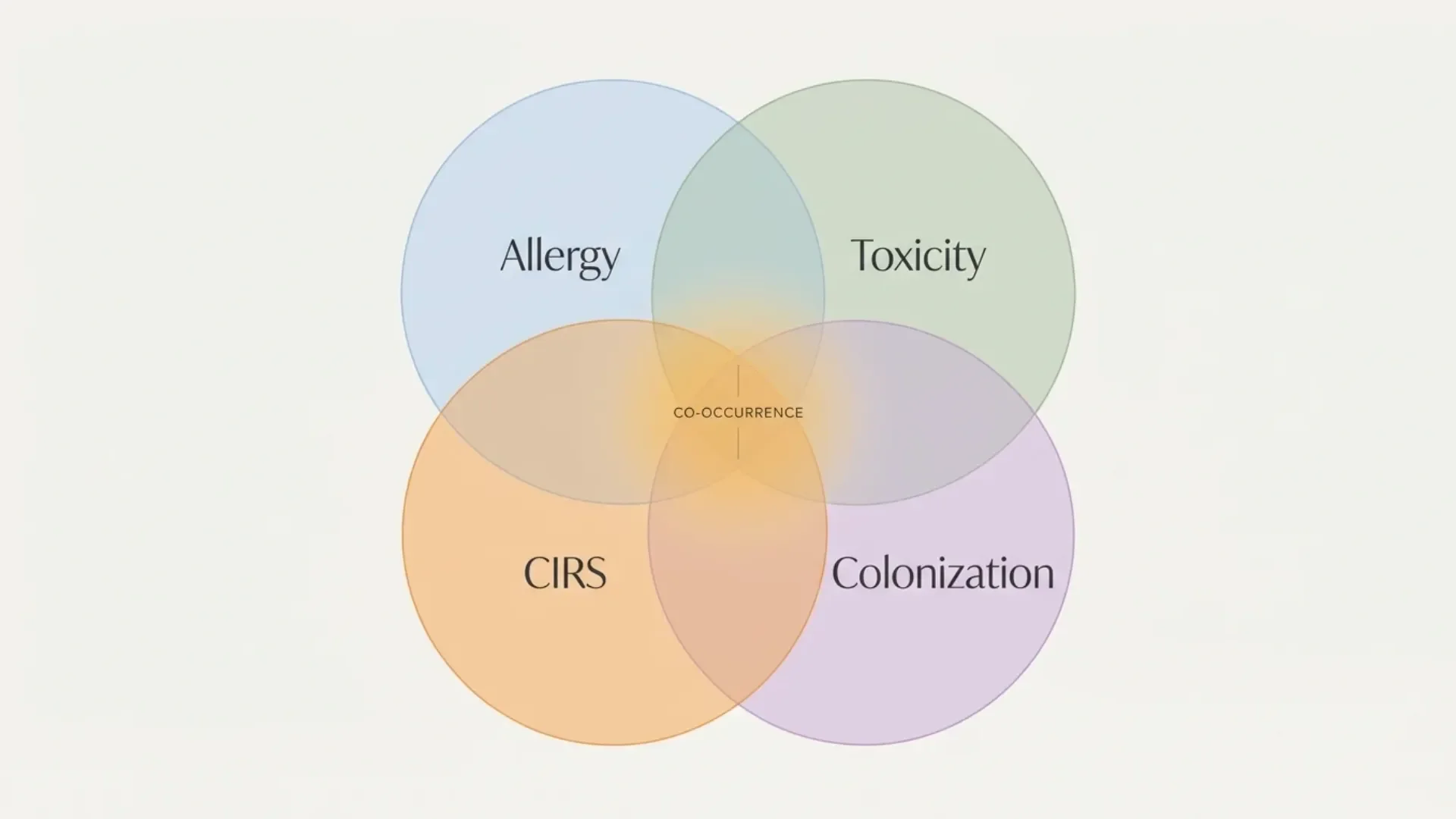
You Might Have More Than One at the Same Time
I want to be clear about something, because it trips people up often. These four categories are not mutually exclusive. You do not get to have exactly one. It is entirely possible, and in stubborn cases fairly common, to have a mold allergy, mold toxicity, fungal colonization, and CIRS at the same time.
In fact, the most difficult and long-running cases I see usually involve several of these problems overlapping and feeding each other. That is exactly why a single-label diagnosis so often falls short, and why someone can get accurately diagnosed with one piece of their illness and still not get well. They had three other things going on that nobody mapped. Sorting out the full picture, and the order in which to address each part, is a huge part of the actual work.
Getting the Diagnosis Right Is the Whole Job
If this feels complicated, that’s because it genuinely is, and anyone who tells you otherwise is oversimplifying something that deserves deeper consideration. But here’s the reassuring part. We can sort this out together. Confusing is not the same as hopeless. Sorting out which of these you have, or which combination, is most of the work of getting you onto a plan that finally fits.
A simple place to begin is the mold symptom assessment I use with new patients. It helps map your symptom pattern and clarify whether mold is likely in the picture at all. From there, proper testing can start to pinpoint which type or types you are dealing with, and we can decide whether working together makes sense for you.
Take the Mold Assessment to start mapping your symptoms toward the right diagnosis.
